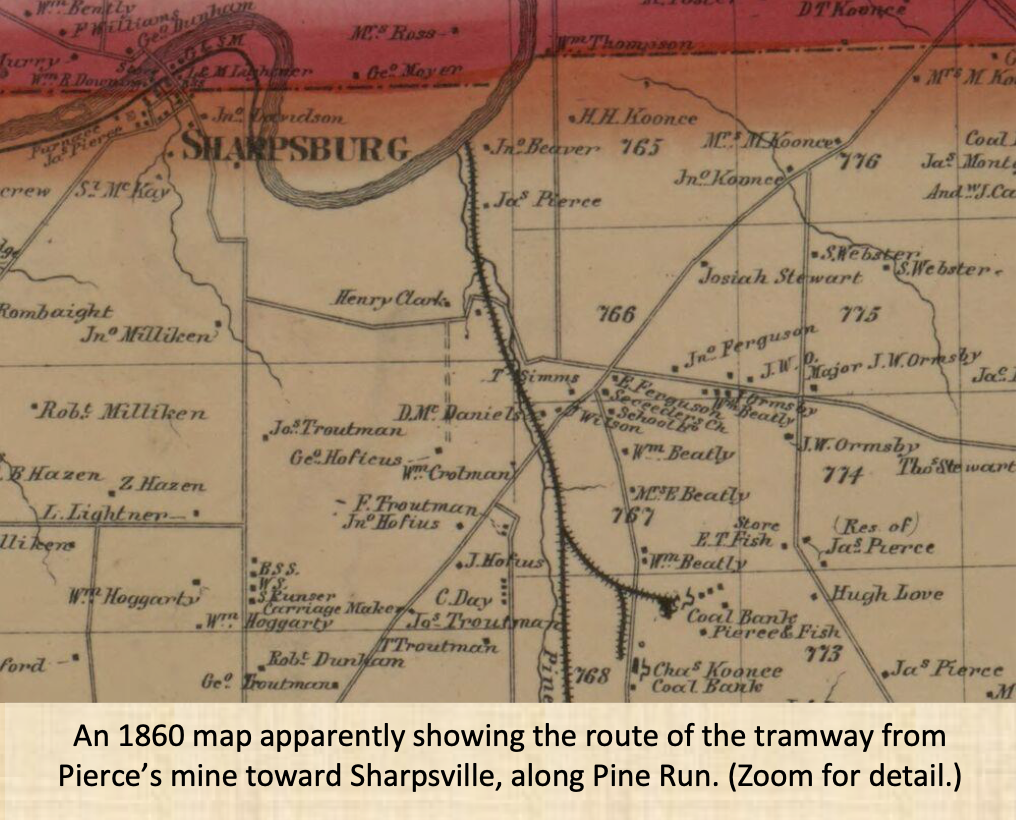
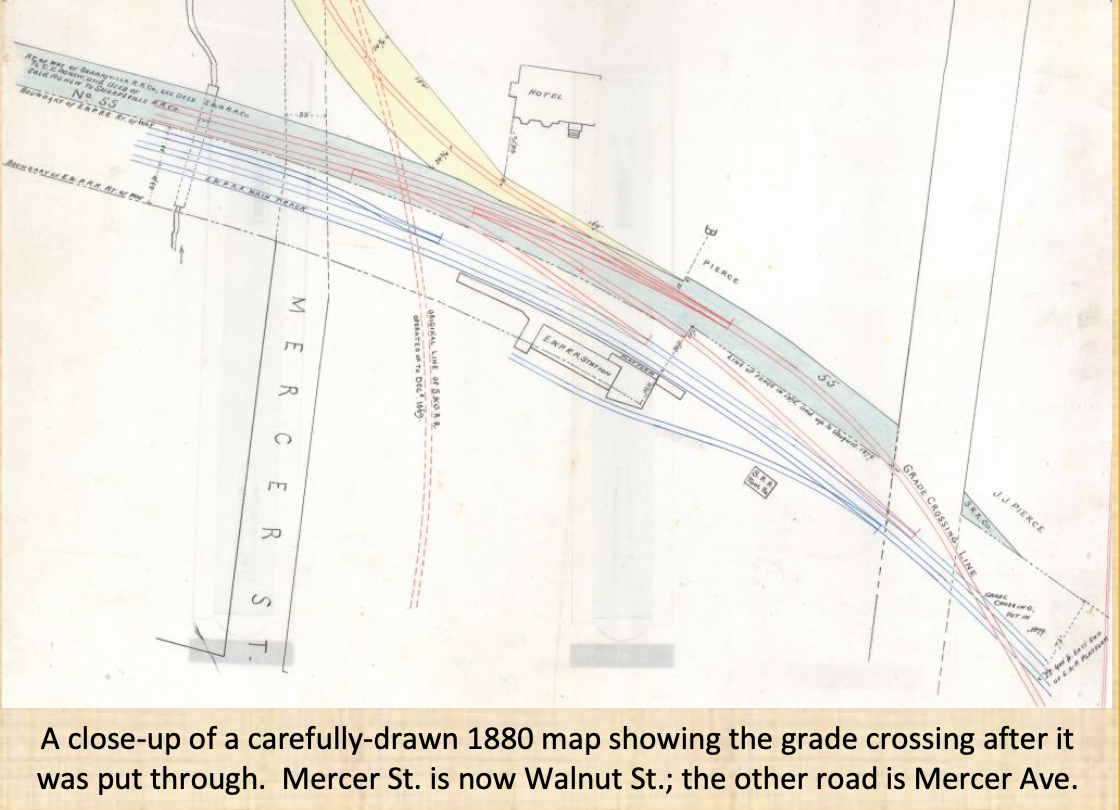
The opening move of the railroad war came in December 1875, when the SRR hauled a shipment bound for the Stewart Iron Company over the Sharon Railway. In order to reach the Sharon Railway, the SRR had to make a short jog using about 100 feet of E&P track, with the entrance and exit on either side of “Big Cut”. (Big Cut was where Mercer Avenue crossed the rail line, at the head of the present Trout Island Trail. When the rail line was closed, the Mercer Avenue bridge that once went over the tracks was filled in. It was so named because it required a large excavation from the hillside.) While this incidental usage had been allowed, without charge, for the Sharpsville Railroad to deliver coal to the furnaces in town, a link with a rival’s tracks would not be tolerated by the Pennsylvania Railroad. The claims and contentions are given in minute detail in 790 pages of legal testimony and exhibits published in a bound volume in 1878 as In the Common Pleas Court of Mercer County, Pa., in Equity, No 2 of August Term, 1876, The Pennsylvania Company, operating the Erie & Pittsburgh Railroad, and the Erie & Pittsburgh Railroad Com’y, vs. The Sharpsville Railroad Com’y. The answers to questions, cross-examinations, and re-directs by the 36 witnesses called between September 21, 1876, and July 31, 1877, are surprisingly unilluminating as to the contending parties’ economic motives. Since the ostensible reason for the legal proceedings was to bar a proposed grade crossing on the east side of Big Cut as unsafe, most of the testimony deals with technical aspects of railroad switches and costs of trackage. The basic desire for the Sharpsville Railroad to have an alternative to sole reliance on the Erie & Pittsburgh line is stated by Walter Pierce. They need to free themselves from overreliance on the demand for coal at Erie is clear; it is uncertain, however, whether the E&P exercised any monopoly power in pricing. Also unsaid is whether the furnace owners at Sharpsville felt the need to break free of the E&P’s stranglehold, both for shipments of incoming ore and outgoing pig iron. (While not parties to the suit in equity, the Pierce family-owned majority stakes in both the Sharpsville Railroad as well as in most of the town’s furnaces, and so would have aligned interests.)
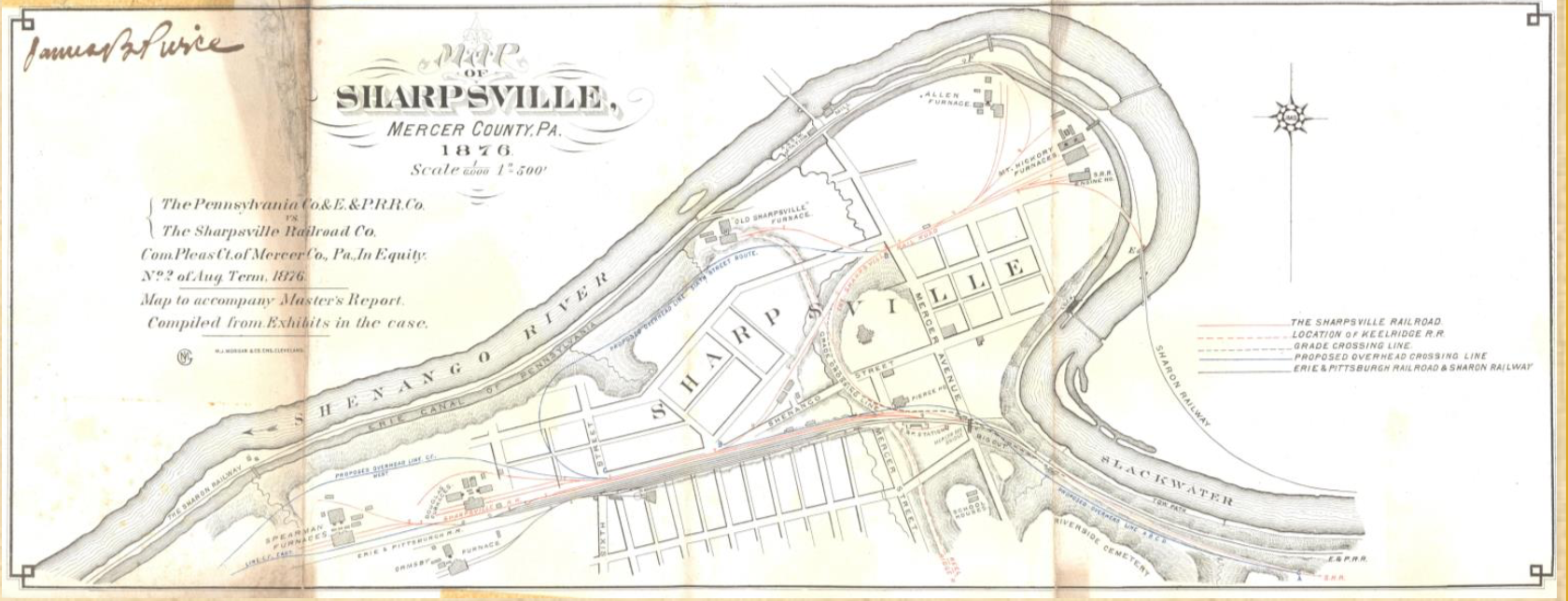
This map was an exhibit of the litigation and showed the past, present, and proposed rail lines referenced in the article. The Pennsylvania Railroad, when made aware of the SRR’s use of their tracks to access the line of a competitor, delivered a telegram to William L. Scott on December 28, 1875; this was followed by a meeting between the officers of the SRR and the PRR on January 4, 1876. The Pennsylvania men emphatically denied any right of passage on the E&P tracks that would divert business from them. Even though the travel was just a short distance, the SRR realized that their position was tenuous. The existing arrangement gave precedence to the E&P traffic, resulting in lengthy waits before the SRR cars could pass through. Now, it was feared that they would be physically barred from access to this section of the track. Their solution was to avoid this length of the E&P’s track and to directly connect the mainline of the SRR and a branch line within Sharpsville that allowed unimpeded access to the Sharon Railway. This connection would require a new grade crossing: basically, an intersection, between the SRR and the E&P. The need for a grade crossing was recognized as early as August 1875 with surveys made that month and the next. On October 2, 1875, this first proposal for a grade crossing was presented to the PRR. James D. Layng, general manager of that great rail system, however, flatly stated that would oppose it “by all means in his power.”Grade crossings do, understandably, increase the risk of a rail accident. Pennsylvania law generally disallows them where a crossing above or below grade (by means of a bridge) is reasonably practicable. This became the point of the suit, with the Pennsylvania Railroad seeking an injunction to stop the Sharpsville Railroad’s proposed crossing. The route for an overhead crossing proposed by the plaintiffs involved running the SRR’s approach into town further uphill toward the Riverside Cemetery and building a bridge over the E&P east of Big Cut. Because descent from this elevated bridge precluded following the existing turn by the Pierce House Hotel toward the Mt. Hickory Furnaces, the track would need to take a wide loop past Sixth Street in order to ultimately reach that destination. Considered the only “reasonably practical” route to avoid a grade crossing the proposed line was called the “Sixth Street Route”. The SRR argued not only the impracticality of these proposals but that both the pre-1869 crossing west of Big Cut and the current connecting switch east of the Cut were mutual agreements between the connecting lines. Even the wages of the switchman was divided equally between the SRR and the PRR. The decision of Common Pleas Court Judge A. McDermitt was to deny the PRR’s request for an injunction to prevent the SRR’s proposed grade crossing. In the ruling handed down until September 21, 1878, the judge noted that the grade crossing issue was a mere cover for the PRR’s desire to maintain their monopoly on connecting traffic from the SRR: “It was not until the Defendant sought transportation for their freight by a rival road that the Plaintiffs became frightened for the public safety.” The original connecting switch installed in December 1869 was used “without let or hindrance” until freight was taken over it “to a competitive Road of the Plaintiffs.” In ruling on whether avoiding the grade crossing would be reasonably practicable, he added two salient points. First, the estimated cost of $60,000 for the overhead crossing must be weighed against the size of the railroad; what would be practicable for a large system would be an undue burden for a short 16-mile line like the SRR. Moreover, the construction of the overhead crossing would require encroachment on the property of Riverside Cemetery, running about 1,000 feet through there and occupying about 10% of its land. The General Railroad Act of 1849 clearly forbade a railroad from “passing through any burying ground or place of public worship.” In this statute, and in subsequent case law, Judge McDermitt found the clear prohibition for even minimal encroachments upon cemetery land.
The Pennsylvania Railroad appealed the decision to the State Supreme Court. (Prior to the 1895 creation of the Superior court, there was no intermediate the appellate court in Pennsylvania.) Perhaps impatient with the slow pace of judicial proceedings Pennsylvania Railroad then sought to change the facts on the ground. On February 25, 1879, their workers pulled up the crossing’s frog (i.e., the Y-shaped rail that allows a connection) of the Sharpsville Railroad. This presaged the tearing up of tracks and scuffles that would occur here five years later. The Pierces, through their organ, The Sharpsville Advertiser, “inflaming headlines, denounces the act as a high-hand outrage” and claimed the jobs of 500 men in the local furnaces and mines were in jeopardy as this affected not just the link to the Atlantic & Great Western but local spurs to the furnaces in Sharpsville. By the following month, the blockade has been raised, allowing the operation of the mines and businesses connecting to it to resume. The SRR brought suit to establish the use of crossing switches and to require the PRR to replace the frog.
In the midst of all of this, the owners of the Sharpsville Railroad sought a second northern route and incorporated the Sharpsville & Lake Shore Railroad. The proposed route would follow the Shenango River upstream to Pymatuning Creek and then branch northwest to Kinsman, Ohio where it would connect to the Mahoning Coal Road’s line to the lake port of Ashtabula, Ohio. The path described would have for the most part paralleled the Atlantic & Great Western. While the new line does not appear that it would somehow have avoided the disputed crossing of the E&P, its mere threat may have been used as a bargaining chip. On the other hand, it may have been considered a hedge against any trouble the A&GW could stir up. An initial survey was completed on May 9, 1879, with a survey of a second southwesterly route starting along McCullough’s Run, and grading said to have begun by late June. Nothing indicates, though, any actual construction of a Sharpsville & Lake Shoreline. On June 10, 1879, the Pennsylvania Supreme Court ruled in favor of the Sharpsville Railroad, with their right to cross the E&P affirmed. The costs of the litigation were to be divided equally between the parties. By July 24, newspapers reported that an “armistice has been declared between the warring railroad companies at Sharpsville”. With an unimpeded grade crossing built at some point in 1879, peace would last at least three years before the conflict would erupt again in our Second Railroad War.